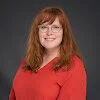
Gather began with Joann Self Selvidge and me talking about the messiest parts of caregiving. Literally the messiest parts. There was laughter. There was commiseration. The caregiving journey had taken a hard left into ‘you cannot make this shit up.’ Nobody was calling it a journey. We were discussing bodily fluids.
We were talking about the daily craziness: the frustration, the difficulty, the things you find yourself doing that would have been unimaginable before they became Tuesday. The absurdity doesn’t cancel out the exhaustion. Sometimes it’s the very thing that lets you exhale.
As we talked, we began to imagine making art from all of it. We wanted to give tangible form to experiences that can be difficult to explain—and exhausting to explain again. What could we do with the paperwork, the supplies, the fragments, the emotional load? What might happen if we brought those things to a table with other people who understood?
We wanted a place to bear witness to one another’s lives. Somewhere we could tell the truth without first making it presentable.
For both of us, caregiving had already shaped how and what we made.
When I was working toward my MFA, caring for my daughter, Virginia Grace, gradually changed the use of my studio. My oil paints gave way to a bedroom, medical equipment, and the space we needed for her care. Her tracheostomy made ordinary childcare largely impossible. The conditions for making art had changed completely.
Creativity continued, though its forms became harder to recognize as art: finding a way through an impossible arrangement, adapting a space, keeping her safe, holding a day together.
Joann’s fiber arts practice ruminates conceptually on the lows and highs of caregiving. She gathers plants to make natural dyes and uses empty vials of human growth hormone shots as resist tools to create surface design impressions of bubbles, starbursts, and black holes.
My own work gravitates toward found objects, fragments, writing, and things whose value is easily overlooked. We came to Gather through those different practices, carrying materials and experiences we wanted room to work with.
Gather, a program of Fierce Mamas, grew from that conversation. ShapeShifter Art School & Gallery has given us space to bring people around a table and see what takes form.
We make things. We bear witness. We laugh and we cry—sometimes at the same time.
What we’ve been making
Over the months, a few connected questions have guided the work: What do we carry? What gets recorded? What disappears from the record? Can you see the person carrying all of it?
Entanglements gave us a place to begin with the material itself. Medical paperwork, bills, packaging, instructions, and other remnants of caregiving became part of The Scroll of Medical Entanglements, a collaborative work that holds individual contributions together.
The Scroll stretches across a table. So does the administrative life of caregiving: the forms, the repeated histories, the instructions, the requests for proof. Brought into a shared artwork, those materials become available to look at differently—to mark, rearrange, interrupt, and place beside someone else’s.
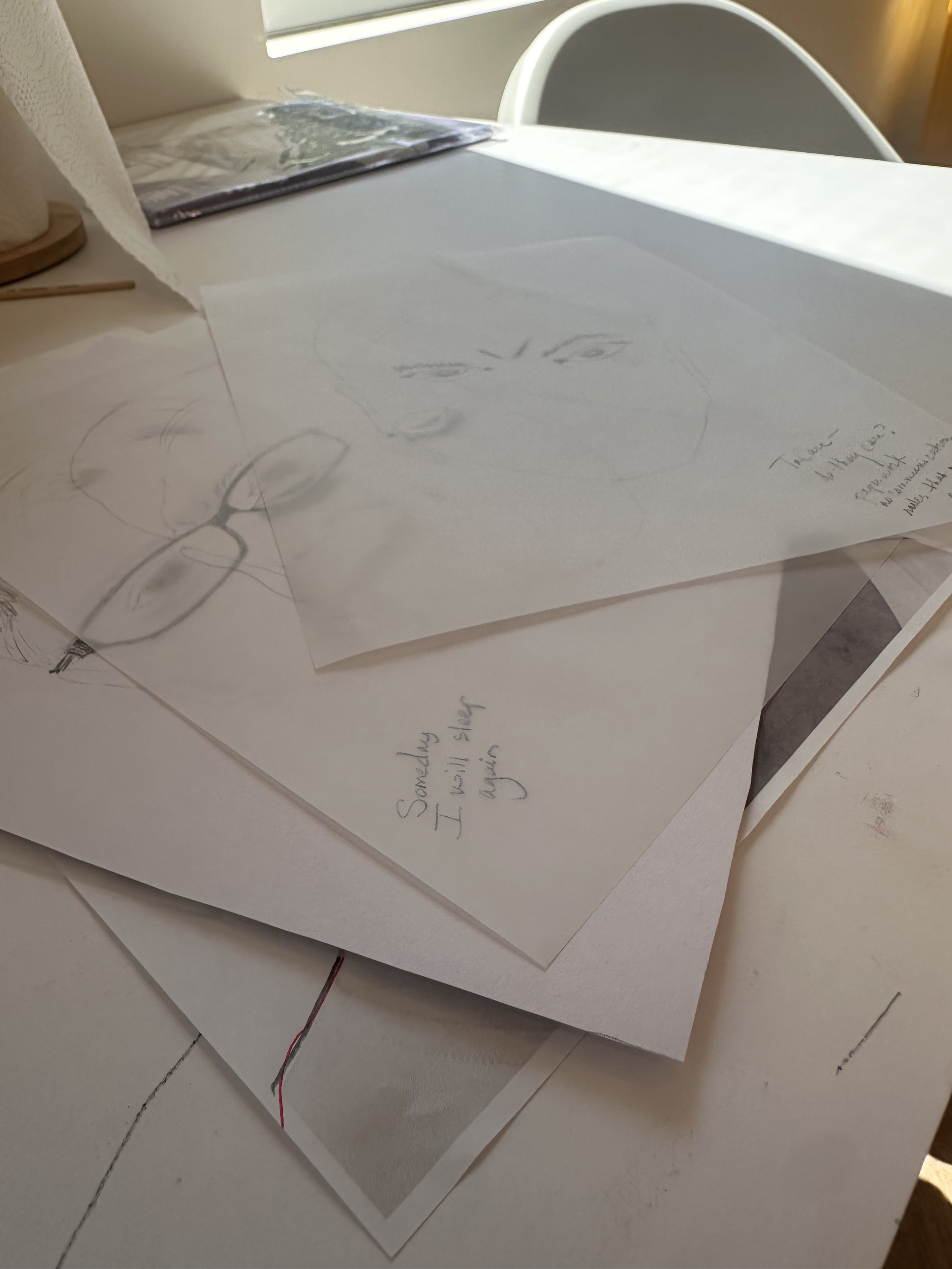
Someday I Will Sleep Again | Seen in Layers
Seen in Layers turns toward the person behind the paperwork. Photographs, translucent materials, words, and images offer ways to explore what others see, what remains less visible, and what we choose to keep for ourselves. A portrait can be assembled through layers. Drawing skill is beside the point.
What the Record Leaves Out brings listening and making into closer conversation. Letters, fragments, marks, and responses to systems offer room for what has never fit neatly on a form. A letter might address an institution, a diagnosis, a former self, or whoever should have been listening.
We’ve also been developing ways to work with personal timelines and visual marks: ways of telling a life alongside, across, or against its medical account. That work is still taking shape.
Each project offers another way into an ongoing practice. The materials and questions change; the people at the table help determine where the work goes.
What happens at a Gather?
We arrive, settle in, and make room for one another.
There is an invitation to listen and an invitation to make. Sometimes we begin with a question, an object, a photograph, or a piece of writing. We might work with paper, collage, translucent layers, or materials from our caregiving lives.
You don’t need art or writing experience. You don’t need a prepared story. Listening is part of participating, and you can pass on any invitation.
When we listen to one another, we practice letting a person’s account stand without rushing to explain it, interpret it, or offer a solution. What someone shares remains theirs. So does the decision about what becomes part of an artwork.
There is room for grief, anger, tenderness, and the story that has everyone laughing in recognition. You don’t have to arrive in a particular mood or leave feeling better. You can bring the day you’re actually having.
There is time to work with your hands, follow a material, change direction, or sit with something unfinished. You choose what to share, what to contribute to a collective piece, and what to take home.
A finished object is one possible outcome. Having time and company for the work matters, too.
Whose experience counts?
The question of being heard extends beyond the table.
In the days after this election, I’m thinking about how important it is to elect people with lived experience—people who understand what a policy asks of a family because they have encountered those demands themselves.
I want to celebrate Jerri Green and how far she went in her race for Tennessee governor. She didn’t win, and the disappointment deserves room. So does recognition of the work she did and the people who saw their concerns reflected in her campaign. Read about the race and her response.
Jerri has spoken publicly about how parenting, including raising an autistic child, informs her concerns about education and the protections families depend on. That connection between daily life and public decisions matters. Hear more from Jerri.
Lived experience doesn’t mean one person understands everyone’s life. It gives someone a place to begin—and a responsibility to listen beyond it. We need leaders who bring that knowledge into the room, seek out what they don’t know, and remain accountable to the people affected by their decisions.
At Gather, we decide what to make visible and on whose terms. In public life, we deserve a say in the conditions we’re living with.
Joann’s show—and a red-carpet detour
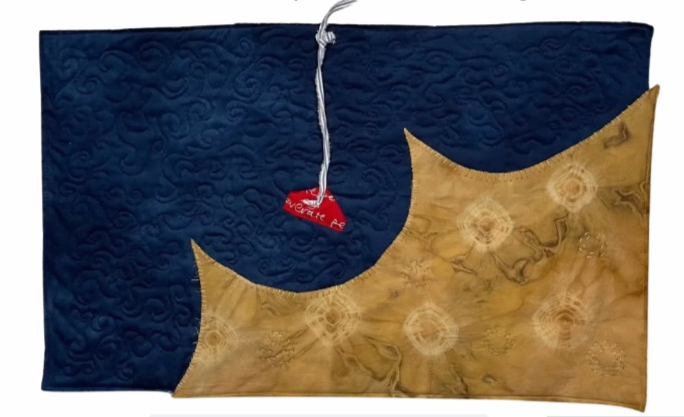
Joann’s solo exhibition, “I’ll Miss You in Dreamland,” opens November 6 at The Medicine Factory. The title comes from something her son Stevie said as she tucked him in one night.
Her new work features non-traditional quilts, a “windows of tolerance” series, naturally dyed silk scarves, and altars made from styrofoam medical shipping containers.
The Scroll will also be there, with a role we originally imagined for it: a step-and-repeat. A red carpet. People posing for photographs. Behind them, the paperwork and material remnants of caregiving.
We were particularly tickled by the thought of hospital executives and politicians having their pictures made in front of it. A photo opportunity with the fine print.
And yes, there will be an actual red carpet.
Come celebrate Joann’s exhibition, then take a small detour. Just off the main exhibition room, near the kitchen and conveniently close to the bar, you’ll find The Scroll of Medical Entanglements. Stop for a photograph in front of the administrative life of caregiving, then add your mark to this ongoing Fierce Mamas collaboration.
We’ll have stamps reading DENIED, PAYMENT DUE ON RECEIPT, and other familiar pronouncements. For once, we get to hold the stamp.
No presentation, no formal unveiling. Just a red-carpet detour through the paperwork.
Opening reception
Friday, November 6 | 5:30–8:30 PM
The Medicine Factory | 85 Virginia Avenue West
Joann’s exhibition runs November 6–20. The Scroll’s red-carpet detour will be available during the opening reception.
One more Gather this year
We’ll meet at ShapeShifter once more before our winter pause:
Sunday, November 8 | 1–4 PM
ShapeShifter Art School & Gallery
There will be time to listen, work with materials, and spend an afternoon together. Come whether you’ve joined us before or this will be your first Gather.
We’ll pick back up in February. For now, there’s one more afternoon at the table.